
In the previous posts in this series, we discussed a parchment sheet from a now-lost codex kept at the Bibliothèque Nationale de France (BnF), BnF Copte 129 (20) fol. 178, dated to around the 10th century, which contains several healing prescriptions, including the already-discussed fumigation prescription for a quick childbirth. In this post, we will take a closer look at a prayer for healing deafness, which mentions Malchus, the servant of the Jewish High Priest Caiaphas, and appears on page 23 of the codex.
BnF Copte 129.20 fol. 178 (135), verso ll. 1–7:
ⲕ̅ⲅ̅
ⲙ̣ⲁ̣ⲁϫⲉ̣ ⲙ̇ⲙⲁⲗⲭⲟⲥ ⲧⲉⲛⲟⲩ ⲇⲉ ⲡ̣ϫ̣ⲟⲉ̅ⲥ ⲓ̅ⲥ̅ ⲡⲉⲭ̅ⲥ̅ ⲉⲕⲉⲥⲟⲟⲩⲧ̣ⲛ̇ ⲛ̇ⲧⲉ̣ⲕϭⲓ̇ϫ ⲉⲃⲟⲗ ⲛⲟⲩ̣ⲛⲁⲙ̣ ⲛⲉⲕϫⲱϩ · ⲉⲡⲉⲓ̇ⲁⲗ ϭⲣⲁϩ · ⲛ ϯⲛ̣ⲁϩⲧⲉ̣ – ϩⲛ̣ ⲧⲉⲕϭⲟ̣ⲙ̣ ⲡ̣ⲛⲟⲩⲧⲉ ⲉ[ⲧⲟⲛϩ ⲁ̅ⲓ̅]ⲱ̅ ⲁ̅ⲓ̅ⲱ ⲧ̅ⲁⲭ̅ⲏ̣̅
(Page 23) […] the ear of Malchus. But now, Lord Jesus Christ, stretch out your right hand and touch this deaf person, … I trust (?) in your power (?), O living (?) God! Yea, yea, quickly!
Below this, we see a dividing line that separates this prayer from another healing prescription, whose meaning remains opaque, and which is discussed at the end of this blog post.
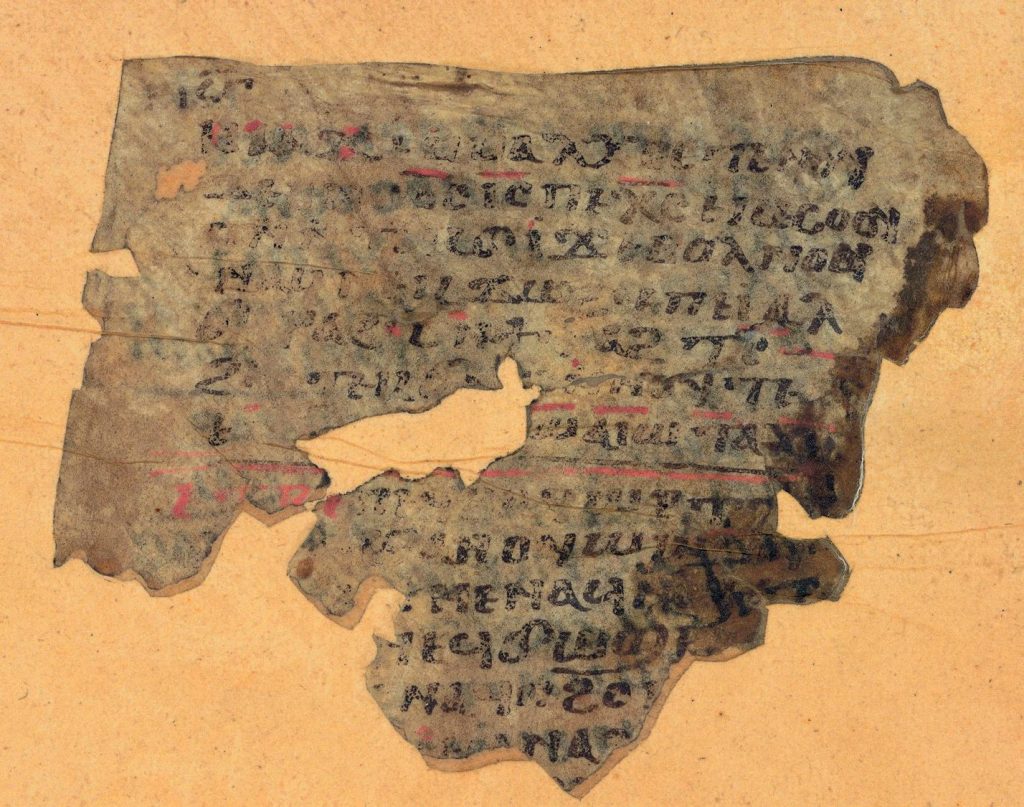
BnF Copte 129.20 fol. 178 (135), verso. Image by courtesy of the Bibliothèque nationale de France, Département des Manuscrits
Although what remains of the prayer is laconic, even these few words and the overall context in which they appear provide us with the most important information. When we compare it with the prescription that precedes and the one that follows, it seems that these recipes were written in the same pattern: first, the symptom was given, followed by instructions on how to proceed with the healing procedure, concluded by a prayer to be recited. Following this logic, what preceded in the now-lost bottom of page 22 were the symptoms and the description of the healing procedure, and what remains is the end of the prayer to be uttered. As the prayer mentions Malchus and a plea to Jesus Christ to heal a deaf person, the goal of the procedure seems clear.
In mentioning Malchus, the prayer refers to John 18:10 and Luke 22:50–51. John and Luke tell the story of how Simon Peter cut off the ear of the servant (in John called Malchus) of the High Priest Caiaphas, trying to prevent the arrest of Jesus. In John’s account, Jesus only tells Simon Peter to put the sword back in the sheath, but in Luke, Jesus heals the servant: “Then, he touched his ear and healed him” (Luke 22:51). These two accounts have been merged to form this prayer; Jesus is asked to heal the deafness of the patient as he once healed the ear of Malchus.
Furthermore, in the sentence “Jesus Christ, stretch out your right hand and touch this deaf person”, there are several elements of importance to this analysis, namely the significance of the right hand of God, the “stretching out of the hand” of God, and the healing efficacy of Jesus’s hand. First, concerning the right hand, Jesus Christ sits at the right hand of God (e.g., Mark 16:19, Luke 22:69), and God’s right hand is understood as especially powerful (e.g., Exodus 15:6). The right hand of Jesus specifically does not seem to be of particular significance in his healings in the New Testament. Second, the “stretching out of the hand” of God has in the Christian context its origin in the Old Testament; specifically, it appears there as the “strong hand”, ⲧϭⲓϫ ⲉⲧϫⲟⲟⲣ, and “outstretched arm”, ⲡϭⲃⲟⲓ ⲉϥϫⲟⲥⲉ, of God. Usually, the context in which these phrases appear emphasizes the power of God’s deeds (e.g., Exodus 6:6, Deuteronomy 4:34, Jeremiah 21:5). As Tonio Sebastian Richter pointed out, this phrase also frequently appears in legal and magical texts, particularly in prayers for justice. Thirdly, the healing touch of Jesus appears prominently in the accounts of his healing miracles.
By mirroring Luke 22:51 through the request for Jesus Christ to touch the deaf person, this prayer amalgamates various biblical traditions into a unique petition for healing deafness. Concerning the possible reconstruction of a ritual procedure for healing deafness, four Coptic prescriptions might be the most relevant, as well as several other Egyptian, Arabic, Latin, and Greek recipes. Coptic healing texts addressing issues related to the ear are relatively uncommon; they are limited to a few pharmacological texts focusing on pain and other issues of the ear, generally by mixing (or mixing and cooking) and applying a substance (in general a plant or a bodily fluid of an animal, such as opium and veal fat as in recipe no. 114 in IFAO Papyrus Médical Copte) into or onto the ear of the patient.
Furthermore, in Arabic prescriptions (from the 10th-century Book on the Useful Properties of Animal Parts), bodily fluids of various animals are mixed with other substances (often oil) and applied in drops into the ear to treat deafness. An example of this is the following recipe: “If wild pigeon fat is taken, mixed with sesame oil, and applied in drops inside the ear that is hard of hearing, then this will open it and it will be useful for the hearing.” Regarding earlier medical sources, according to Aulus Cornelius Celsus (1st century CE), “[t]he dropping in of the juice of unripe grapes mixed with rose oil is also fairly efficacious against deafness”. Hippocrates of Kos (5th–4th century BCE), in Epidemics, talks of cleaning – likely the ear – with wool, and pouring in olive oil or oil of bitter almonds (and rising early and drinking white wine) to cure deafness. Lastly, one of the oldest references from Egypt comes from Papyrus Ebers 764 (ca. 16th to 13th century BCE), which recommends mixing red ochre, leaves of the jꜣm tree, and olive oil, and applying the medicine to the ear to improve hearing. So, in the recipe in question, one might expect a mixture based on oil, either of plant or animal origin, to be warmed so that it liquifies, mixed with other ingredients, and poured in drops into the ear to cure the deafness; however, since the passage is lost, this remains a mere hypothesis.
The very last recipe preserved on page 23 is very fragmentary and might be translated in the following way: Against the/his (?) … when he eats… for him (?)… and pour into/mix (?)… for him (?)… A prayer which presumably followed the instructions is lost.
Although only two pages from this ancient manuscript survive, they provide interesting information regarding the intersection of medicine, liturgy, and magic in the context of monastic healing. Apparently, the prescriptions contained a “medical” recipe followed by a prayer to accompany it. Furthermore, the prayers belong to the type of the so-called Paradigmengebeten, which refer to biblical instances of divine intervention serving as templates for how God, Jesus, or other beings should help the suffering. However, the prayers also include elements typically classified as “magical,” such as the phrase “quickly, quickly,” which do not typically occur in liturgical contexts. Lastly, because the codex was produced in a monastic context, it raises interesting questions regarding the involvement of monks in “magical” healing and childbirth.
Bibliography
Grons, Anne. Medizinische Rezepttexte in koptischer Sprache (C.Pharm.Copt.). Archiv für Papyrusforschung und verwandte Gebiete – Beiheft 56. Berlin: De Gryter, 2025.
Preininger, Markéta. “BnF Copte 129 (20) fol. 178: Three Healing Prescriptions.” Archiv für Papyrusforschung und verwandte Gebiete 68, no. 2 (2022): 344-357.
Raggetti, Lucia. ʿĪsā ibn ʿAlī’s Book on the Useful Properties of Animal Parts: Edition, Translation, and Study of a Fluid Tradition. Berlin – Boston: De Gryuter, 2018.
van der Vliet, Jacques. “Christian Spells and Manuals from Egypt.” In Guide to the Study of Ancient Magic, 322–350. Leiden: Brill, 2019.