
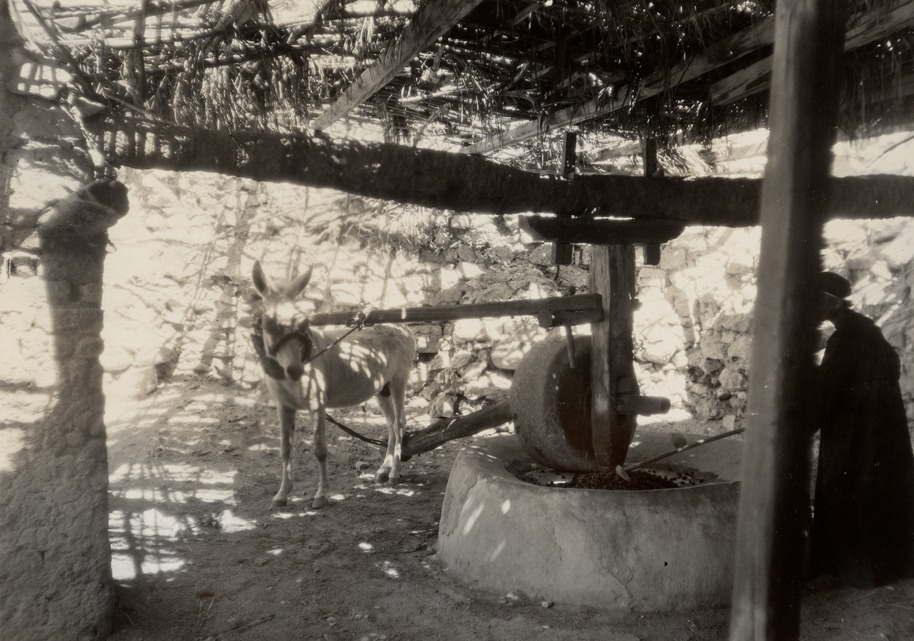
As we have seen in this series, animals played an important role in the imaginations of Egyptian Christians, but they had an equally, if not more important, material role. In an age before steampower or electricity, animals served as a major “power source”: horses, donkeys, camels, and cattle would transport goods and human riders across hundreds or thousands of kilometres, serve as mounts or logistical support in war, compete in races, or turn wheels to irrigate fields or mill grain. Other animals would serve other roles – sheep providing wool, cows and goats producing milk used to make cheese, chickens laying eggs which could be eaten, and all of these animals, as well as pigs and doves, could be slaughtered for their meat, even if this would have been a rare luxury for most Egyptians.
For this reason, the wellbeing of domestic animals was of major concern to Egyptians and their families. As Ariel López has discussed, the loss of livestock could be disastrous for people who did not belong to the wealthy elite; in a sixth-century petition in Greek from Middle Egypt, a tenant farmer tells his former patron that “three years ago my livestock died and I ran away from home”, presumably no longer able to maintain his farm and pay his rent. Because of this importance, letters in Coptic often begin with wishes for wellbeing, including that of the addressee’s animals, even before mentioning their children:
Firstly, I greet all of you. May the Lord bless all of you, men and animals, and all your children and all their children … (MPER XVIII 162, ll. 1-8)
As we might expect, this importance meant that domestic animals often appear in magic, both as vulnerable beings in need of amulets, and as targets against whom curses could be used to harm their owners.
One of the largest surviving late antique medico-magical collections is a composite work focused on healing horses, the Hippiatrica, compiled in the fifth or sixth century, but preserved in much later copies. One of the original authors whose work was added to this collection was Apsyrtus, a fourth century doctor, who wrote down instructions for an amulet, one of the earliest surviving ‘magical’ texts to mention the Christian Trinity:
Apsyrtus’ beneficial, preserving, and wondrous gift, effective for livestock.
(Formula:) Iao, Iae, in the name of the Father and of our Lord Jesus Christ and of the Holy Spirit, iriterliestather, nochthai brasax, salolam narkazeo maza areous daroucharael ablanathal bathiaketh dryth toumalath poumadoin chthou chthou litiotan mazabates maner opsachiou ablanathaleba iao iae in the name of the Father and of our Lord Jesus Christ and of the Holy Spirit.
Inscribe this with a bronze stylus on a clean tin strip from a seal, and wrapping it in waterproof leather, affix it wherever you wish. Having inscribed the strip, cense it with storax. (Translation after McCabe 2007)
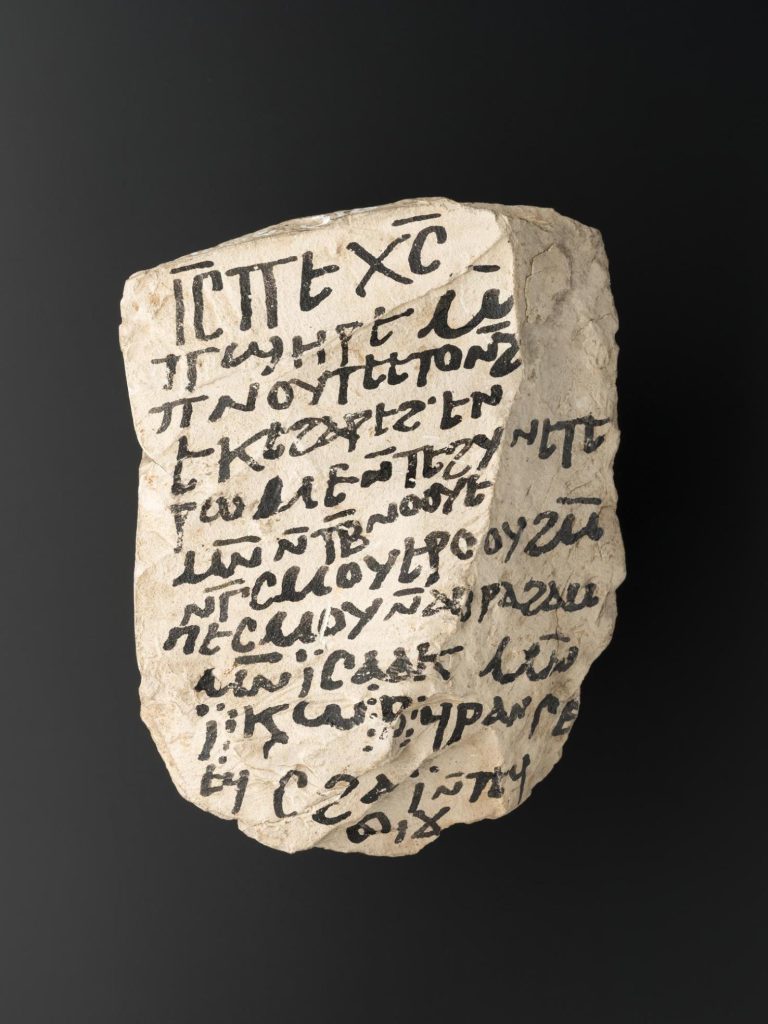
Horses were particularly expensive animals, both to buy and to maintain, and their owners were therefore generally wealthy. Among other evidence for amulets for horses is a very interesting text from eighth-century Thebes in Upper Egypt, written by a monk named Frange, hundreds of whose letters survive from around the desert tomb in which he lived. In one of these he writes to his correspondent, telling him to “please put this cord on your mare, and tie the blessings on her neck so that the Lord will bless her and watch over her for you.” These “blessings” (smou) were probably requested by the laypeople who wrote to him; in another letter he writes to a certain Azarias, telling him that “since you have written to me, ‘Write a big ostracon and send it to me so I can place it in front of the animals’, look, I have sent it, my good brother” (O.Frange 190). This ostracon was probably for protecting not one horse (like the cord and small text in the previous letter), but probably a whole flock of herd animals, perhaps in an enclosure, in which the ostracon would be placed. One such amuletic ostracon, written in Frange’s handwriting, even survives:
(Front:) Jesus Christ the Son of the Living God, may you watch over the men of the monastery and the animals, and may you bless them with the blessing of Abraham and Isaac and Jacob! Frange writes with his ⟨own⟩ hand.
(Back:) + Jesus Christ the Son of the Living God. May you bless the monastery with every blessing that is written in the Scripture! Have mercy on us in love, O Lord, Jesus Christ! ⲭⲙⲅ + Amen (Crum ST 18)
This prayer seems to draw on liturgical language, adapting it to serve as a “blessing”, a type of amulet generally acceptable to the Christian Church, but other texts, more clearly part of the tradition of magical texts, often offer similar protection for animals. PCM I 26 contains a long and complex prayer attributed to Michael, which survives in two copies of the tenth- and eleventh-centuries. While its original purpose was to protect a man or woman from evil, many other uses were added to the copy in PCM I 26, including one to protect livestock:
An enclosure of livestock to which an act of sorcery has been done against you. Draw the bird-faced power. Bury it inside it. It will be completely undone. Offering: mastic. (Fayum, X CE; PCM I 26 p. 17, ll. 10-12)
The “bird-faced power” was probably an angel, perhaps a six-winged, eagle-headed one resembling one of the Four Creatures described in Revelation 4.6-8. What is interesting here, though, is that the protection is not simply against any harm, but specifically against “sorcery” (hik), hostile magic which has been done to hurt their owners. We have some surviving examples of such hostile magic – a curse to bind a pet dog, a curse to infect cows with ticks, and another (unpublished) example, (P.Monts.Roca 324 hair side ll. 6-8), with the title “a procedure for laying down a man or animal (with sickness)”; the ritual involves copying an image of a demonic being, and burning it with salt while burning incense.
As this last example shows, one of the reasons that animals needed amulets, and could be harmed with curses, is that they were very similar to humans, to the extent that rituals developed for humans could be used on animals, and vice versa. For Egyptian Christians of the first millennium CE, animals represented some of their most valuable possessions, but, unlike grain, expensive fabrics, or coins, they could not be locked up in chests or hidden. Instead, animals, like humans, had to exist in a social world in which they were exposed to the threats of disease, violence, the evil eye, the attacks of demons, and hostile magic.
Bibliography
Boud’ hors, Anne & Chantal Heurtel. Les Ostraca Coptes de la TT 29 autour du moine Frangé (2 vols). Brussels: CReA- Patrimoine, 2010.
An edition of many of the texts written by the monk Frange.
Dosoo, Korshi. 2020. “Circe’s Ram: Animals in Greek Magic”, in Animals in Ancient Greek Religion, edited by Julia Kindt. London: Routledge, 260-288.
A discussion of the role of animals in Greek magic.
Dosoo, Korshi. 2022. “Suffering Doe and Sleeping Serpent: Animals in Christian Magical Texts from Late Roman and Early Islamic Egypt”, in Korshi Dosoo and Jean-Charles Coulon (eds.), Magikon Zōon: Animal et magie dans l’Antiquité et au Moyen Âge | Animal and Magic from Antiquity to the Middle Ages. Paris-Orléans: Institut de recherche et d’histoire des textes, 2022, 495-544.
A discussion of the role of animals in Christian magical texts from Egypt; the discussion in this post is based on pages 510-514 of this article.
Dosoo, Korshi, and Markéta Preininger. Papyri Copticae Magicae. Coptic Magical Texts, Volume 1: Formularies, Archiv für Papyrusforschung und verwandte Gebiete – Beihefte. Berlin: De Gruyter, 2023.
Edition of Coptic magical texts, including PCM I 26 discussed above.
Gitton-Ripoll, Valérie. 2022. “Incantations pour les chevaux”, in Magikon Zōon: Animal et magie dans l’Antiquité et au Moyen Âge | Animal and Magic from Antiquity to the Middle Ages, edited by Korshi Dosoo and Jean-Charles Coulon. Paris-Orléans: Institut de recherche et d’histoire des textes, 445-465.
A discussion of the magical practices to protect and heal horses in the Hippiatrica.
Lazaris, Stavros. 2024. “Considérations sur la période d’activité d’Apsyrtos, hippiatre grec”, Archives internationales d’histoire des sciences 73, 6-37.
A discussion of Apsyrtus and the amulet translated above.
López, Ariel G. Shenoute of Atripe and the Uses of Poverty, Berkeley, University of California Press, 2013.
A study of the social world of fifth-century Egypt.
McCabe, Anne. 2007. A Byzantine Encyclopaedia Of Horse Medicine: The Sources, Compilation, and Transmission of the Hippiatrica. Oxford: Oxford University Press.
An overview of the Hippiatrica and its history.
Piwowarczyk, Przemysław. 2023. “Coptic Texts of Ritual Power as Voices of Laypeople”, in Shaping Letters, Shaping Communities: Multilingualism and Linguistic Practice in the Late Antique Near East and Egypt, edited by Yuliya Minets and Paweł Nowakowski. Leiden: Brill, 268-295.
A discussion of the identities of magical practitioners, which includes mention of the role of monks, including Frange, in producing “blessings”.