
In this series, we will take a look at the biblical story of the bleeding woman from Capernaum, the Haemorrhoissa, and its reception in the magical context. In this first post of the series, we will discuss the biblical narrative of her healing and its reception in selected Coptic sources. The story of the bleeding woman appears in the Synoptic Gospels (Matthew 9:20‑22; Mark 5:25‑34; Luke 8:43‑48) and recounts the pain and healing of a woman who had been suffering from uterine bleeding until she was cured by touching Jesus’ garment. The Latin term Haemorrhoissa, used to designate this woman in later literature, comes from the Greek γυνὴ αἱμορροοῦσα, “a woman who had been suffering from a hemorrhage” (Mt 9:20). As early as the early fifth century, the bishop of Ravenna, Peter Chrysologus, already used the term in a sermon; among theologians, as well as among laypeople, as we shall see, her story was discussed early on.
The fullest account of her healing appears in Luke (8:43‑48):
Now there was a woman who had been suffering from hemorrhages (ⲉⲓⲥ ⲟⲩⲥϩⲓⲙⲉ ⲇⲉ ⲉⲣⲉⲡⲉⲥⲛⲟϥ ϩⲁⲣⲟⲥ) for twelve years; and though she had spent all she had on physicians, no one could cure her. She came up behind him and touched the fringe of his clothes, and immediately her hemorrhage stopped. Then Jesus asked, “Who touched me?” When all denied it, Peter said, “Master, the crowds surround you and press in on you”. But Jesus said, “Someone touched me; for I noticed that power had gone out from me”. When the woman saw that she could not remain hidden, she came trembling; and falling down before him, she declared in the presence of all the people why she had touched him, and how she had been immediately healed. He said to her, “Daughter, your faith has made you well; go in peace”.
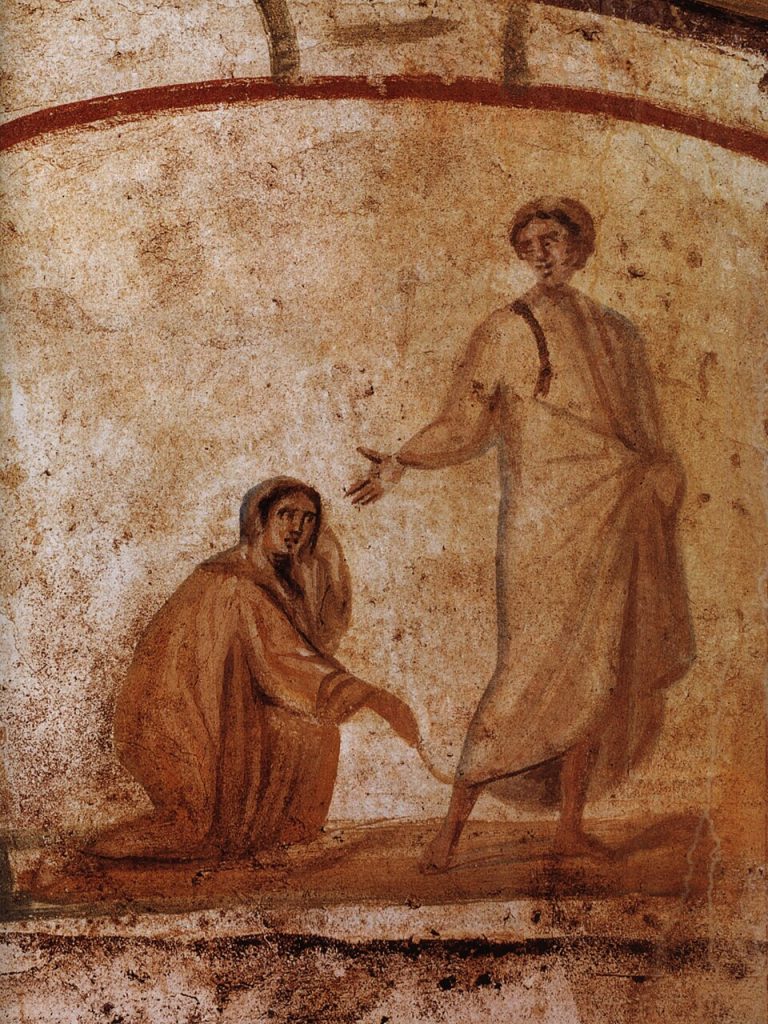
Healing of the Haemorrhoissa (Catacombs of Marcellinus and Peter, Rome, 4th century CE). Source: Wikimedia Commons.

The reader of our blog posts might recognize the Coptic phrase used for menstrual and uterine bleeding, used in the Sahidic version of the passage (ⲡⲉⲥⲛⲟϥ ϩⲁⲣⲟⲥ, “blood underneath her”), discussed in a post on a healing prayer. The woman was suffering from unstoppable bleeding, and nothing could cure her. Typically, ancient sources do not distinguish between menstrual and pathological uterine bleeding and use the same term for both.
The Haemorrhoissa heard of Jesus’ miraculous healings and decided to approach him. A passage from Mark 5:28 explicitly lays out her motivation: “If I just touch his clothes, I will be healed”. As touching the garment of Jesus was an established technique of his miraculous healing (Matthew 14:36; Mark 6:56), these stories might have encouraged her actions: “And all in the crowd were trying to touch him, for power came out from him and healed all of them” (Luke 6:19).
As she anticipated, the haemorrhage stopped as soon as she touched his garment. But something surprising occurred – it happened without Jesus’ knowledge. “Who touched me?” he asks. Peter dismisses the issue, implying it is hard to identify the person among the crowd. But Jesus insists, “Someone touched me; for I noticed that power had gone out from me” (δύναμιν ἐξεληλυθυῖαν ἀπ’ ἐμοῦ, Luke 8:46). The woman came forward, although she was scared, admitted it was her, and declared that she was healed, to which Jesus responded that it was her faith that healed her.
A paradox occurred. In Capernaum, although many people pressed against him, only the woman was healed. However, we know from other accounts that touching the garment of Jesus could cure entire crowds. Two concepts are crucial for understanding this paradox: faith (Greek πίστις/Coptic ⲡⲓⲥⲧⲓⲥ) and power (Greek δύναμις/Coptic ϭⲟⲙ). Faith is relational and implies intentionality; the woman believed in Jesus and his healing abilities, and this belief was conscious. The concept of power is elusive, but in this story, it appears within a mechanical process – touch results in the power coming out from Jesus and heals the woman. When the woman touched Jesus, an essential property of Jesus’ power—healing—accidentally affected the woman. This idea of essence and accident comes from Aristotle’s Metaphysics; an essence constitutes the fundamental nature of a thing, but accidents are properties that can be gained or lost without affecting the object’s essence. Healing constituted the essence of Jesus’ power, guided by the woman’s faith, and accidentally affecting her.
The story is recounted and reinterpreted in several Coptic texts. The Coptic Life of Bishop Pisentius by John the Elder contains a reference to the story of the bleeding woman, introducing it as a testimony of the “power of faith” (ⲧϭⲟⲙ ⲛ̅̅ⲧⲡⲓⲥϯⲥ) of the woman (Budge 1913, 85, 271). In this account, Pisentius combined the notions of power and faith. Acknowledging the importance of the touch, he also highlights the immaterial efficacy of faith, locating the ‘power’ within ‘faith’ itself, making any intermediaries for power (such as the garment of Jesus in the Gospel or any amulet) irrelevant for the healing. Shenoute of Atripe finds the idea that Jesus would not know who touched him inconceivable, dismissing the narrative tension of the story: “not only did he know that the flow of blood had been with her for twelve years, but he knew her from when she was in her mother” (Brakke, Crislip 2015, 271). The story was retold again in a different context, this time the miraculous healing of a bleeding woman was attributed to a fourth-century saint, Apa Apollo, whose tomb later became a site of pilgrimage renowned for its healing qualities:
And again, one time, as the torch bearer of the Holy Spirit, our holy father Apa Apollo, was coming out of the monastery, a bleeding woman sought him out in firm faith. She touched the fringe of his garments, and that which happened through our Saviour, he granted to his (male) servant. In the moment the woman touched the hem of his garments, the flow of blood stopped. Then she departed, glorifying the Lord and this saint Apa Apollo (Pierpont Morgan MS M.579 (fol. 144, page 29 ll. 23–28 and 30 ll. 1–3), edition by Kuhn 1978, 29–30, translation MP).
In this story, Apa Apollo became the intermediary between the woman and Christ, who are linked through the act of touch.
As we observe, in these later Coptic sources, the role of the touch is diminished, and the importance of faith is enhanced, while emphasising that the healing occurred through Christ, not through the power that came out from him. However, after this brief introduction, in the following blog posts, we will take a closer look at how this narrative was explicitly employed in magical contexts to bring about healing and how it made explicit references to the healing touch.
Bibliography:
Brakke, David, and Andrew Crislip (eds). Selected Discourses of Shenoute the Great: Community, Theology, and Social Conflict in Late Antique Egypt. Cambridge:Cambridge University Press, 2015. URL
E.A. Wallis Budge. Coptic Apocrypha in the Dialect of Upper Egypt. London: British Museum, 1913. URL
Calhoun, Robert M. “Metalepsis in Narrative Charms and Miracle Stories.” In Narrative Hermeneutics, History, and Rhetoric. A Festschrift for David P. Moessner, edited by Robert M. Calhoun et al, Novum Testamentum, Supplements 194. Leiden: Brill, 2024, 45–102. URL
Kuhn, Karl H. A Panegyric on Apollo: Archimandrite of the Monastery of Isaac by Stephen, Bishop of Heracleopolis Magna, vol. 2, Corpus Scriptorium Christianorum Orientalium 394, Scriptores Coptici 39. Louvain: Secrétariat du Corpus SCO, 1978. URL
Peter Chrysologus. Divi Petri Chrysologi archiepiscopi Ravenatis sermones nunc primum in vulgus editi. Bologna: Giovanni Battista Faelli, 1534.
Preininger, Markéta. “Transforming Words into Efficacious Objects: The Case of the Bleeding Woman,” Quotidiana 1 (2025): 29–54. URL
Tuerk, Jaqeuline. “An Early Byzantine Inscribed Amulet and Its Narratives.” Byzantine and Modern Greek Studies, 23 (1999): 25‑42. URL