
It has been a busy year for the Coptic Magical Formularies project. We have been working hard towards the publication of the second volume of Papyri Copticae Magicae. We estimate that this will be about four hundred pages long, and consist of three major archives – the British Library Portfolio, the Michigan Coptic ‘Wizard’s Hoard’, and the Collège de France Coptic magical archive. These archives give us an excellent range of perspectives on what different types of magical handbooks looked like, and the ways in which their copyists and users produced and interacted with them. We hope that the full draft of the volume will be finished in 2027, with publication following shortly thereafter.
As part of our work on these exceptional manuscripts, we decided for the first time in July of this year to publish our drafts of unpublished texts online in our database, Kyprianos. The full details can be found in our update notes, but this increased the number of texts in the database by over a third, to 355. We will continue to improve the text and notes of these editions, but we hope that in the meantime it will be useful to colleagues and others interested in Coptic magic to have access to these previously untranslated texts.
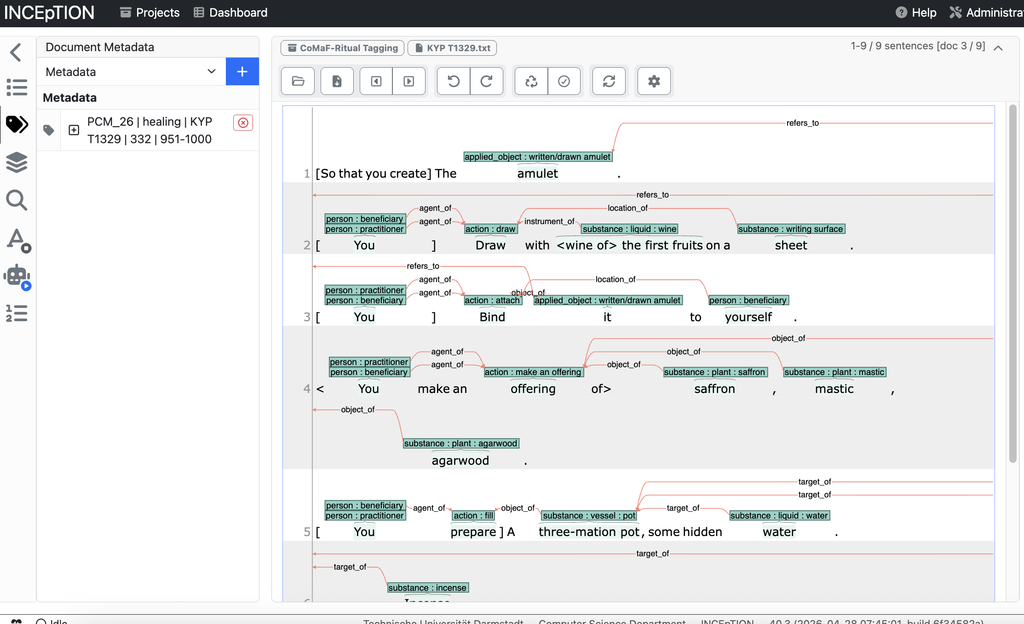
The team has also been working on a new ritual tagging system using the INCEpTION platform. The aim of the tagging is to identify ritual patterns in relation to ritual elements. In practice, when enough texts are tagged, we hope to trace patterns across rituals, such as these: Which types of rituals used wine? In which rituals was it required to draw an angelic figure? Is there a particular relationship between, e.g., the use of oil and favour spells? Electronic tagging of ritual elements might help us identify connections which we would otherwise miss.
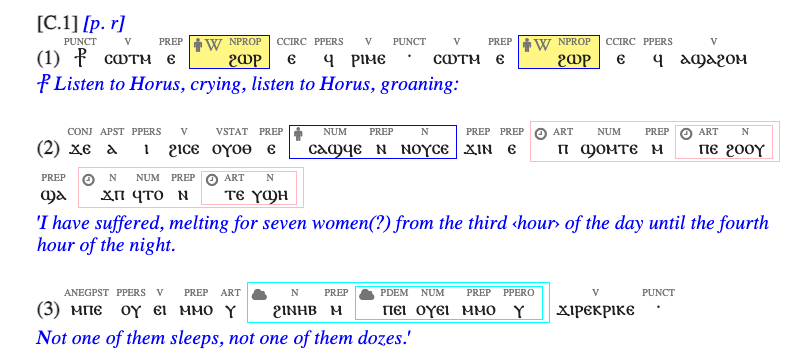
We have also been working with the fantastic Coptic Scriptorium project to make magical texts available through their platform in a lemmatised format. This work is particularly valuable, since it makes them searchable through ANNIS, linked to the Coptic Dictionary Online, so that research on Coptic grammar and lexicography using these resources will be able to take into account magical material alongside literary texts.
Our blog posting continued, with five posts this year (not counting our database update), looking at the roles of angels in Coptic magic, healing prescriptions against deafness and menstrual or uterine bleeding, and practices relating to domestic animals.
Our project members also produced quite a few publications this year. There were three books:
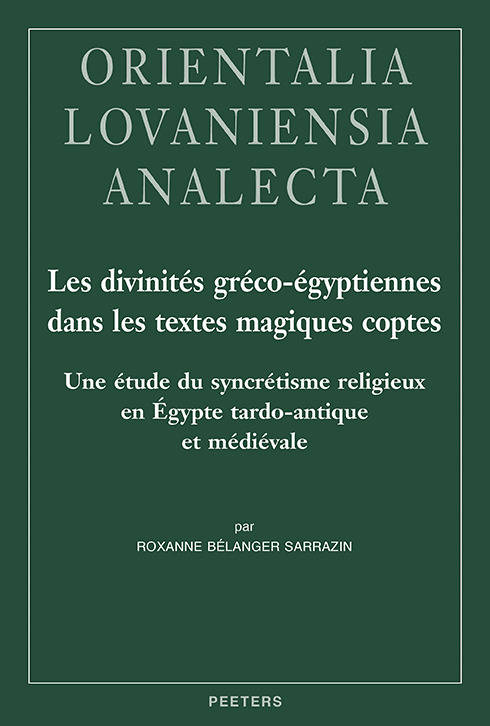
- Roxanne Bélanger Sarrazin, Les divinités gréco-égyptiennes dans les textes magiques coptes: Une étude du syncrétisme religieux en Égypte tardo-antique et médiévale (Orientalia Lovaniensia Analecta; Leuven: Peeters, 2025).
This book offers a systematic study of twenty-two Coptic magical texts invoking Greek and Egyptian deities (or narratives featuring them), from Late Antique and medieval Egypt (4th–11th centuries). It examines the processes used by the ritual experts to appropriate these ancient deities and narratives, and incorporate them into magical texts containing Christian elements. This study thus sheds new light on the transmission of magical knowledge in Antiquity, as well as the process of religious transformation in Late Antiquity and the medieval period.
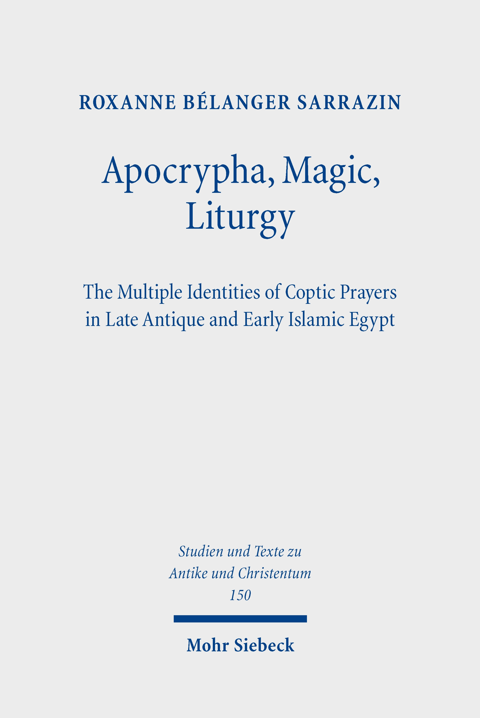
- Roxanne Bélanger Sarrazin, Apocrypha, Magic, Liturgy: The Multiple Identities of Coptic Prayers in Late Antique and Early Islamic Egypt (Studien und Texte zu Antike und Christentum; Tübingen: Mohr Siebeck, 2027).
This monograph examines a group of Coptic prayer texts referred to in modern scholarship as “magical liturgies”, preserved in manuscripts from the 5th–13th centuries. Drawing on the sociological concept of multiple identities, it explores how these prayers can, from an etic, scholarly perspective, be described as “magical”, “liturgical”, and “apocryphal”. This approach illuminates how the prayers might have been conceptualized and used by people in Late Antique and early Islamic Egypt, and the role they played in the elaboration of Christian identities.
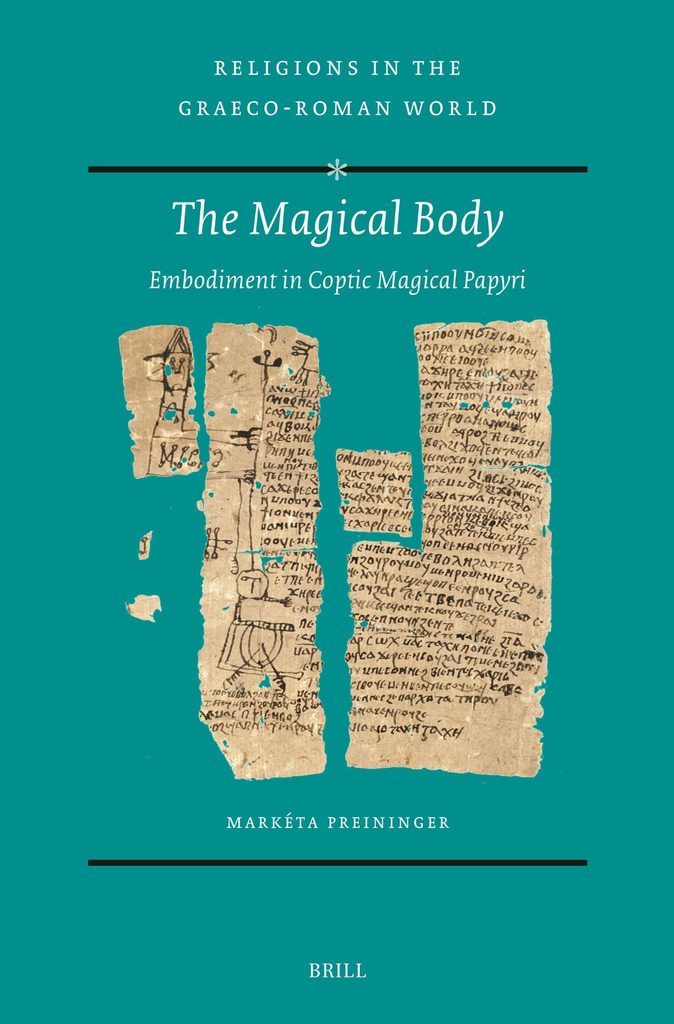
- Markéta Preininger, The Magical Body: Embodiment in the Coptic Magical Papyri. Religions in the Greco-Roman World 202, Leiden (Boston: Brill, 2026).
The lived experience of individuals from Late Antique and Early Islamic Egypt is the subject of this study. By focusing on Christian ritual texts for private use written in Coptic, this book gives voice to those whose lives the ancient manuscripts reflect, revealing how they used ritual practices and amulets to navigate fear, health, and social conflicts. Reconstructing various “bodies”—from the social, female to the divine—the book explores the intersection of ritual action and bodily metaphor. This volume offers a unique, intimate glimpse into the lived religion and private lives of a long-lost world.
And nine articles:
- Roxanne Bélanger Sarrazin, ‘Of Nodes and Names: Exploring Designations and Representations of the Four Bodiless Living Creatures in Coptic Traditions Through Content Network Analysis’, in Hugo Lundhaug, Roxanne Bélanger Sarrazin, Samuel Peter Cook, Florian Graz, and Lasse Løvlund Toft (eds), Coptic Apocrypha: New Frontiers – New Perspectives (Tübingen: Mohr Siebeck, 2026) 99–143.
Using methods from Network Analysis, this chapter studies various traditions about the Four Bodiless Living Creatures (e.g., how they are described and represented, their roles, and names) in Coptic apocryphal literature, liturgy, and magic, as well as wall paintings from Egypt and Nubia. - Korshi Dosoo, ‘The ‘Aberdeen Scribe Dossier’: Four Early Coptic Curses’, in From Dakhleh to Dublin. Essays in Honour of Iain Gardner, edited by Malcolm Choat, Jason BeDuhn and Jay Johnston (Nag Hammadi and Manichaeans Studies 108. Leiden: Brill, 2026, 137–192.
This article examines a small dossier of curses from the late fourth or early fifth century, written in an unusual variant of the Akhmimic Coptic dialect, and invoking the saints and angels to bring violent and unpleasant suffering upon the commissioner’s enemies. This article examines the tradition of Christian “prayers for justice” to which these curses belong, and argues that they may reflect a local Upper Egyptian practice centred on a particular shrine near Akhmim. - Korshi Dosoo, ‘Egyptian Linguistic Influence in GEMF 57/PGM IV, Part 1: The Greek Text’, in New Approaches to the Great Paris Magical Codex (PGM IV/GEMF 57), edited by Christopher Faraone and Sofía Torallas Tovar. Berlin: De Gruyter, 2026, 129–180.
- Korshi Dosoo, ‘Egyptian Linguistic Influence in GEMF 57/PGM IV, Part 2: The Old Coptic Texts’, in New Approaches to the Great Paris Magical Codex (PGM IV/GEMF 57), edited by Christopher Faraone and Sofía Torallas Tovar. Berlin: De Gruyter, 2026, 101–127.
These two articles examine ‘Egyptian influence’ in GEMF 57/PGM IV, the largest surviving Greek magical papyrus from Roman Egypt. The first part examines Egyptian influence on the Greek text, looking at how a first-language Egyptian speaking scribe left traces of his native language in misspellings, and how older Egyptian influence can be seen in Egyptian loanwords and code-switching. The second article re-examines the Egyptian-language ‘Old Coptic’ sections, arguing that they represent the product of multiple layers of different dialectal influences, but suggesting on the whole the transmission of written Old Coptic texts from the north of Egypt to the south, where GEMF 57/PGM IV was produced. - Korshi Dosoo, ‘Medea, the Magi, and the Memorandum of Aeëtes: Notes on the Mithras Liturgy’, in From PGM IV to GEMF 57: New Approaches to the Great Paris Magical Codex, edited by Christopher Faraone and Sofía Torallas Tovar. Berlin: De Gruyter, 2026, 233–273.
Since it was given its name by Albrecht Dieterich in 1903, the so-called “Mithras Liturgy” of the Great Magical Papyrus of Paris has become the most famous of the texts of the Greek magical papyri, re-edited and translated numerous times. Much of the discussion surrounding it has focused on its cultural background – is it, as Dieterich suggested, an adaptation of a liturgical text produced by a Mithraic cultic group, or should it be understood rather an initiatory text produced by Egyptian priests in Alexandria, or is the apparently Mithraic and Egyptian content merely a frame for a primarily Stoic, Neoplatonic, or Pythagorean worldview? This article approaches the question from a different angle, beginning with new readings produced in the course of the Greek and Egyptian Magical Formularies project. The new edition suggests that the Mithras Liturgy is a letter from Aeëtes, legendary king of Colchis, to his daughter Medea, situating it in the tradition of pseudonymous treatises written by legendary figures of the past to their children, produced in late Hellenistic and Roman Egypt. This new framework helps us to understand both minor details of the text as well as its overall structure and content. - Korshi Dosoo, ‘Magic as Cultural Crossroads’, in A Cultural History of Magic. Vol. 1. Antiquity, edited by Esther Eidinow and Richard Gordon (London: Bloomsbury, 2025, 49-69).
From their discovery in the 19th century, the Graeco-Egyptian and Coptic magical manuscripts have been understood as a complex melange of Greek, Egyptian, Jewish, Christian, “Gnostic”, and Mesopotamian elements, though at different times, and in the work of different scholars, some of these elements have be stressed, leading to others being downplayed or even denied. This takes these questions, and the similar problems surrounding the later Greek and Coptic material from Christian Egypt, by first providing an overview of the evidence for different cultural influences in the corpus of magical texts from Roman Egypt in Demotic, Greek, and Coptic from the 1st century BC to the 7th century AD. - Christian Vassallo, Nathan Carlig, and Korshi Dosoo, “Amedeo Peyron and the History of Coptic Papyrology: With a Description of Two Unpublished Magical Texts From the “Fondo Peyron” of the Biblioteca Nazionale Universitaria di Torino (Mss. 158–159)”, in Coptica Taurinensia: Coptic Papyri from the Museo Egizio, edited by Susanne Töpfer, Lajos Berkes, Anne Boud’hors, Costanza Bianchi, Esther Garel, Frederic Krueger, Tonio Sebastian Richter, Gesa Schenke. Turin: Museo Egizio, 2025, 25-46.
This article focuses on the role of Amedeo Peyron (1785-1870) as a pioneer in the study of the Coptic language, but includes an appendix describing an unpublished Coptic magical text for a good singing voice. - Markéta Preininger, “Blood in Coptic Magical Texts and Beyond,” in Les fluides corporels en Égypte et au Proche-Orient anciens. Actes du colloque organisé à l’Université Paul-Valéry, Montpellier, 5–7 septembre 2019, edited by Clémentine Audouit, Elena Panaite, and Bernard Mathieu, 239–250. Orbis Biblicus et Orientalis 309. Leuven; Paris; Bristol: Peeters, 2025.
This paper aims to make a step towards understanding aspects of symbolic meaning of blood in Coptic magical texts. Blood appears in Coptic magical texts in various contexts – some texts evoke the blood of Christ, certain curses wish to make a woman bleed, healing texts hope to prevent haemorrhage. Here, a detailed, anthropological analysis of two phenomena concerned with blood are given: the use of menstrual blood as ink in rituals and the idea of blood as a metaphor for exchange and as a life-giving fluid. These concepts are explained against the background of other sources written in Coptic. - Markéta Preininger, “Transforming Words into Efficacious Objects: The Case of the Bleeding Woman,” Quotidiana 1 (2025): 29–54.
The miraculous healing of the bleeding woman, Haemorrhoissa, as known from Mt 9:20‑22, Mk 5:25‑34, and Lk 8:43‑48, has been reinterpreted and inscribed onto several ‘magical’ objects to help women recover from gynecological hemorrhage in Egypt (and elsewhere) during the sixth or seventh century. The retelling of the story and the mechanics of healing through these efficacious objects are the focus of this article.
As always, if you would like to read an article produced by a team member, but don’t have access to it, please feel free to contact us to receive an offprint. In the meantime, thanks to everyone who has reached out to us, read our work, and supported us over the last year!